Why Carnallite Salt Is Different from Epsom Salt - And Why It May Provide Broader Mineral Support
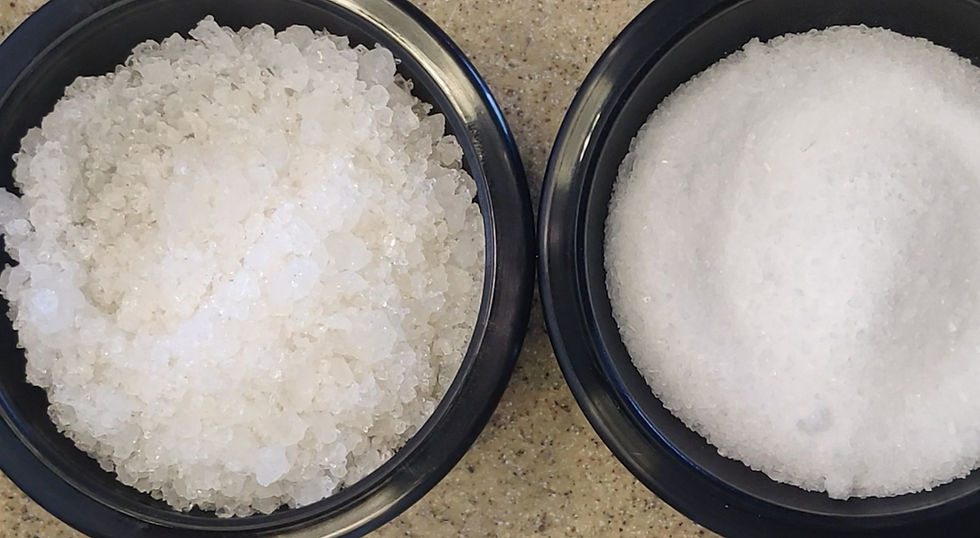
When people think of mineral baths, they often compare Epsom salt with Carnallite mineral salt. While both contain magnesium, they are fundamentally different in composition.

Epsom salt is a single-compound mineral made almost entirely of magnesium sulfate (MgSO₄).

Natural Jordanian Carnallite, on the other hand, is a rare mineral naturally formed over thousands of years in the Jordan Dead Sea region. Its primary minerals are:
Magnesium chloride (MgCl₂)
Potassium chloride (KCl)
Naturally occurring trace minerals
Naturally low sodium chloride (NaCl) - approximately 3%
Instead of providing just one mineral compound, Carnallite offers a naturally balanced mineral profile that more closely resembles the body's own electrolyte environment.
Magnesium and Potassium: A Natural Partnership
One of the biggest differences between Carnallite salt and Epsom salt is the presence of potassium.
Magnesium and potassium work together in virtually every cell of the human body. They play essential roles in:
Normal muscle function
Healthy nerve signaling
Cellular energy production (ATP)
Maintaining electrolyte balance
Supporting normal heart function
The sodium-potassium pump (Na⁺/K⁺-ATPase), one of the body's most important cellular transport systems
Because these minerals function together, a natural source that contains both offers a broader mineral profile than magnesium alone.
Magnesium Chloride vs. Magnesium Sulfate
Another important difference is the form of magnesium itself.
Carnallite naturally contains magnesium chloride, while Epsom salt contains magnesium sulfate.
According to the U.S. National Institutes of Health (NIH), magnesium chloride is among the more bioavailable forms of magnesium when taken orally.
Chloride also plays important physiological roles, including helping maintain:
Fluid balance
Acid-base balance
Normal stomach acid production
Proper nerve function
Naturally Low in Sodium
Unlike many bath salts, Jordanian Carnallite is naturally low in sodium chloride (NaCl).
This means magnesium and potassium remain the dominant minerals instead of sodium.
That unique mineral balance is one of the characteristics that distinguishes authentic Jordanian Carnallite from many conventional bath salts.
Why Do So Many People Prefer Carnallite Baths?
At this time, there are no clinical studies directly comparing Carnallite salt with Epsom salt.
However, there are important scientific reasons why many users report a different bathing experience.
Carnallite provides:
✓ Magnesium and potassium together
✓ Magnesium in the form of magnesium chloride
✓ A naturally occurring multi-mineral composition
✓ Naturally low sodium chloride
While research has not conclusively shown that large amounts of magnesium are absorbed through healthy skin, bathing in mineral-rich water exposes the skin to a much broader spectrum of naturally occurring electrolytes than Epsom salt alone.
The Bottom Line
Both Epsom salt and Carnallite mineral salt have their place in wellness rituals.
However, they are not the same mineral.
Epsom Salt
Magnesium sulfate (MgSO₄)
Single mineral compound
Jordanian Carnallite Mineral Salt
Magnesium chloride (MgCl₂)
Potassium chloride (KCl)
Naturally occurring trace minerals
Naturally low sodium chloride
Multi-mineral composition
Rather than offering only magnesium sulfate, authentic Jordan Dead Sea Carnallite provides a naturally balanced combination of minerals that reflects the unique geology of one of the world's most extraordinary mineral deposits.
If you're looking for a mineral bath that delivers more than a single ingredient, Carnallite Mineral Salt from Jordan's Dead Sea offers a naturally richer mineral experience. Additional Scientific References
Gröber U. et al. "Myth or Reality - Transdermal Magnesium?" Nutrients, 2017.
National Institutes of Health (NIH), Office of Dietary Supplements. Magnesium Fact Sheet for Health Professionals.
Jahnen-Dechent W., Ketteler M. "Magnesium Basics." Clinical Kidney Journal, 2012.
de Baaij J.H.F. et al. "Magnesium in Man: Implications for Health and Disease." Physiological Reviews, 2015.
Volpe S.L. "Magnesium in Disease Prevention and Overall Health." Advances in Nutrition, 2013. With passion Anna


Comments